The Topkapı Scroll: the pattern book that shaped Islamic art
Discovered in the Topkapı Palace archives, the 15th-century Topkapı Scroll contains 114 geometric designs that revealed how Islamic patterns were actually constructed.
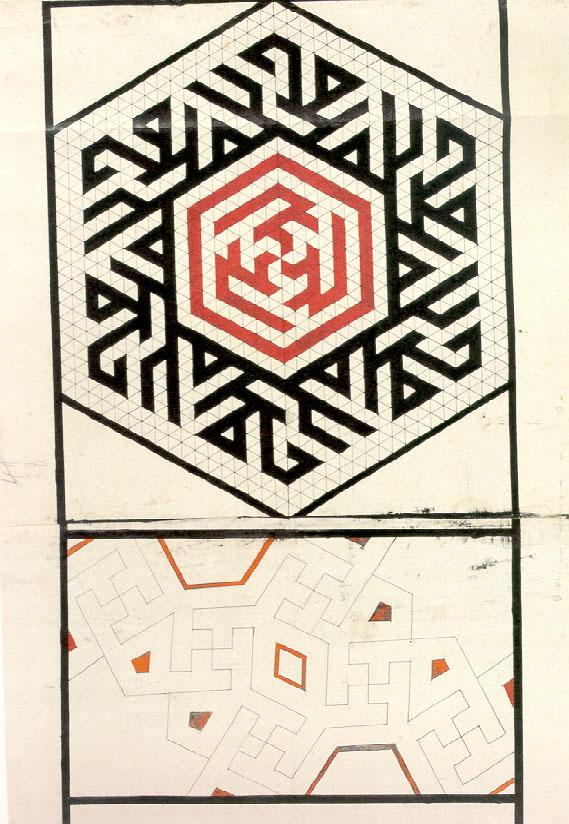
The Topkapı Scroll is a late 15th-century Persian or Central Asian roll of paper, roughly 33 metres long, containing 114 geometric and architectural designs. It was discovered in the Topkapı Palace Museum archives in Istanbul and published comprehensively by Gülru Necipoğlu in her 1995 book The Topkapı Scroll: Geometry and Ornament in Islamic Architecture. The scroll is the closest thing the field of Islamic geometric design has to a Rosetta Stone — a primary source that revealed how master craftsmen actually constructed their patterns, with construction lines visible alongside the finished compositions.
This post covers what the scroll is, why it matters, what it shows, and how it has reshaped the modern understanding of Islamic geometric design.
What the scroll is
The Topkapı Scroll (Museum reference H. 1956) is a long roll of paper containing carefully drawn architectural and ornamental designs. The paper is dated to the late 15th or early 16th century, and the style suggests it was produced in the Timurid or early Safavid sphere of influence — Iran, Central Asia, or possibly the Aq Qoyunlu confederation. It came into the Topkapı Palace library through Ottoman acquisition of earlier Islamic manuscript collections.
The designs include muqarnas (the three-dimensional honeycombed vault structures), wall and floor patterns, dome plans, and a range of two-dimensional geometric tessellations. Importantly, many of the drawings show construction lines — the underlying ruler-and-compass geometry that produces the visible pattern — alongside the finished design. This is what makes the scroll so valuable. It documents not just what the patterns looked like but how they were made.
Why the scroll matters
Before Necipoğlu's 1995 publication, scholars studying Islamic geometric design had to reverse-engineer the construction methods from the finished work. They could see the patterns but had to guess at the techniques. The Topkapı Scroll showed the techniques directly.
Three specific findings transformed the field.
Construction by construction lines, not by computation. The scroll's drawings show that master craftsmen worked by physical construction — drawing radial lines, finding intersections, constructing polygons by classical Euclidean methods — rather than by computing dimensions. This had long been assumed but was now documented in primary sources.
The use of "polygonal technique." Many of the scroll's patterns are built up from a small set of underlying polygonal tiles that are then decorated with specific patterns to produce the visible design. The polygons themselves remain invisible in the finished work but determined its geometry. This is the same mechanism Lu and Steinhardt would later identify as the basis of quasi-crystalline tilings.
Multi-scale or "two-level" patterns. Several of the scroll's designs show patterns at multiple scales simultaneously — a large pattern that contains smaller patterns inside its component shapes. This explains a feature of many medieval Islamic monuments (the Darb-e Imam shrine in Isfahan being the most famous example) where the same pattern logic operates at both metres-wide architectural scale and centimetres-wide detail scale. Wichmann Chapter 15 covers two-level patterns in depth.
The Lu and Steinhardt connection
In 2007, Peter Lu and Paul Steinhardt published a paper in Science arguing that 15th-century Persian craftsmen had effectively figured out aperiodic tessellation — patterns that don't repeat but use only a small set of tile shapes — centuries before Roger Penrose described it formally in 1974. Their analysis drew heavily on the Topkapı Scroll.
The argument: the scroll's drawings show a method of pattern construction using five specific tile shapes (the "girih tiles") combined in ways that produce decagonal symmetry without periodic repetition. The same method appears in the actual tile work of the Darb-e Imam shrine. The patterns are quasi-crystalline in the precise mathematical sense — they have well-defined rotational symmetry but no translational symmetry, the defining feature of quasi-crystals in modern physics.
This is one of the more striking results in the entire history of the relationship between art and mathematics. Persian craftsmen working in the 1450s had effectively figured out a mathematical theory the West wouldn't develop until the 1970s, and they did it without formal mathematical training. The Topkapı Scroll is the smoking-gun documentation that they were systematically using this method, not stumbling on it by chance.
For more on this connection, see the math behind Islamic geometric patterns and what is girih.
What the scroll doesn't say
Important to be honest about the limits.
The scroll doesn't include explanatory text. The designs are drawn but not annotated; we have to infer purposes and methods from the drawings themselves. Some designs are clearly architectural plans (the muqarnas drawings), some are clearly tile patterns, but many are ambiguous in function.
The scroll doesn't identify its maker. We don't know who drew it, where, or for whom. The geographical attribution comes from stylistic analysis, not from documentation in the scroll itself.
The scroll is one document among many that have probably existed. Pattern books and design albums must have been common in Islamic court workshops — Necipoğlu identifies several references in other primary sources — but very few survive. The Topkapı Scroll is precious partly because it's nearly unique among surviving pattern documents from this period.
How the scroll has shaped contemporary practice
For practicing artists, scholars, and designers working in the tradition, the Topkapı Scroll has become a standard reference. Eric Broug's books cite it extensively. Adam Williamson's workshops teach methods derived from its drawings. Contemporary digital tools — including my own SVG Stack Studio for layered paper work — implement the polygonal technique the scroll documents.
For the broader history of how Islamic geometric design has been studied and rediscovered, see Owen Jones and the Western rediscovery of Islamic art and a short history of Islamic geometric art.
Accessing the scroll
The scroll itself is held by the Topkapı Palace Museum and is not on public display. Scholars access it through the museum's archives by appointment.
The most accessible way to engage with the contents is through Necipoğlu's 1995 book, The Topkapı Scroll: Geometry and Ornament in Islamic Architecture, published by the Getty Center. The book includes full reproductions of all 114 designs, scholarly commentary, and the most authoritative analysis available. It's an academic publication but readable by motivated non-specialists.
A second valuable source is the Lu and Steinhardt 2007 Science paper, which is freely available online and includes detailed discussion of specific Topkapı patterns and their relationship to the Darb-e Imam shrine. The paper is technical but the main argument is accessible.
FAQ
What is the Topkapı Scroll?
The Topkapı Scroll is a late 15th-century roll of paper, roughly 33 metres long, containing 114 geometric and architectural designs. It was found in the Topkapı Palace Museum archives in Istanbul. The scroll is the most important primary source for understanding how Islamic master craftsmen constructed their patterns, because the drawings show construction lines alongside finished designs.
Who discovered the Topkapı Scroll?
The scroll was held in the Topkapı Palace library for centuries and was identified as an important pattern source by various scholars in the 20th century. Gülru Necipoğlu's 1995 book published the complete scroll for the first time and provided the comprehensive scholarly treatment that established its importance.
Can I see the Topkapı Scroll in person?
The scroll is held by the Topkapı Palace Museum and is not on public display. Scholars can access it by appointment through the museum's archives. The most practical way to engage with the contents is through Necipoğlu's 1995 book, which reproduces all 114 designs.
Why is the Topkapı Scroll considered the Rosetta Stone of Islamic geometric design?
Because it documents how patterns were actually constructed, not just what they looked like. Before the scroll's publication, scholars had to reverse-engineer construction methods from finished work. The scroll shows the underlying construction lines, the polygonal technique, and the multi-scale design methods that produced patterns previously considered mysterious.
Sources
- Necipoğlu, Gülru. The Topkapı Scroll: Geometry and Ornament in Islamic Architecture. Getty Center, 1995. The complete published source.
- Lu, Peter J., and Paul J. Steinhardt. "Decagonal and Quasi-Crystalline Tilings in Medieval Islamic Architecture." Science 315 (2007).
- Wichmann, Brian, and David Wade. Islamic Design: A Mathematical Approach. Springer, 2017. Chapter 15 covers two-level patterns.
- Topkapı Palace Museum, Istanbul.
Owen Jones, Bourgoin, and the Western rediscovery of Islamic art
How Owen Jones, Jules Bourgoin, and Prisse d'Avennes brought Islamic geometric design into Western consciousness in the 19th century — and shaped modern design.
8 min readThe Alhambra: a guide to its geometric patterns
The Alhambra in Granada contains the world's richest concentration of Islamic geometric tile and stucco. A guide to its patterns, rooms, and history.
8 min readThe khatem: the 8-pointed star at the heart of Moroccan tile work
The khatem or 8-pointed star anchors more than 140 documented Islamic geometric patterns. A guide to its geometry, history, and significance.
7 min read
See the work.
Mahmoud's first solo exhibit opens at Meridian Arts Centre during Toronto Doors Open, May 23–24, 2026.