Commissioning Islamic art: a guide for mosques, schools, and institutions
A practical guide to commissioning original Islamic art for mosques, schools, and homes. Process, timeline, costs, and what to ask before you start.
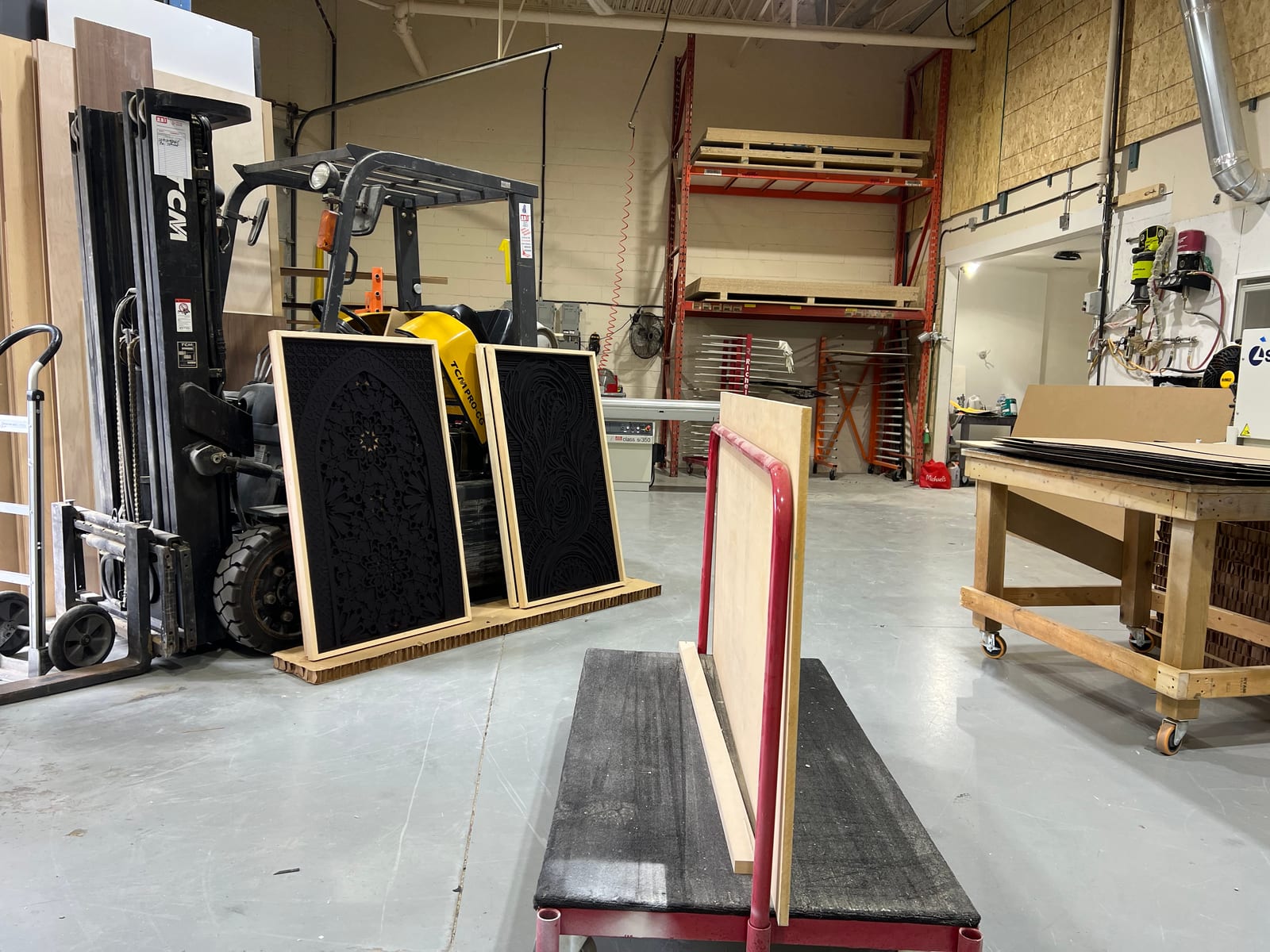
Commissioning custom Islamic art is something most institutions and homeowners do once or twice in their lives, and that lack of repeat experience is why the process can feel opaque. There are real questions on both sides: how much should this cost, how long does it take, how do you describe what you want to someone you've never worked with, and what happens if the result isn't quite right. This guide walks through the actual mechanics so you can have an informed conversation with any artist you're considering, including me. The principles are the same whether the work is layered paper, zellij, calligraphy, or something else.
Most commissions in this tradition fall into three buyer categories: institutions (mosques, Islamic schools, community centres, Muslim-owned businesses) commissioning pieces for public spaces; homeowners commissioning for their living rooms, foyers, or prayer rooms; and gift-givers commissioning for weddings, new homes, or milestones. Each has different considerations, but the process is the same.
How much does it cost?
Commissioned Islamic art ranges from roughly $1,500 for a small custom piece to $25,000+ for a large institutional installation, with most commissions in the $3,500–$8,000 range. The factors that move the price:
- Size. A 24×24 inch piece sits at the bottom of the range; a 4×8 foot mural sits near the top.
- Complexity. A simple rosette is faster to design and produce than a 24-pointed star surrounded by octagonal tile work. Layer count, in my work specifically, drives material and labor cost.
- Materials. Cut tile (zellij) costs more than painted layered paper. Carved wood costs more again. Hand-illuminated work in gold leaf is the most expensive category.
- Calligraphy element. If the piece includes Arabic calligraphy of a specific verse, the calligrapher's fee adds $500–$3,000 depending on the script and length.
- Installation. For institutional pieces, installation might require travel, hardware, and on-site work. Budget another 10–20% for this.
For context: a mid-sized mosque commission (e.g., a 5×7 foot arabesque panel for an entrance lobby) typically lands at $6,000–$12,000 with installation. A custom piece for a home (e.g., a 36×36 inch piece in colors matching the room) lands at $2,500–$4,500. My own commission tier starts at $3,500.
How long does it take?
Six to twelve weeks from signed agreement to delivery, broken down roughly as follows:
- Week 1–2: Discovery conversation, brief, and concept agreement
- Week 2–4: Design phase. The artist produces 2–3 design directions; you choose one and request revisions.
- Week 4–10: Production. The actual making — cutting, painting, assembly, framing.
- Week 10–12: Finishing, packaging, delivery, and installation.
Rush commissions are possible but cost 25–50% more. Allow at least four months of lead time for any commission tied to a specific event (Ramadan, Eid, a building opening, a wedding). Don't commission three weeks before the event and expect a good outcome.
The seven questions worth asking any artist
Whether you're talking to me, Eric Broug, one of the Moroccan masters of zellij, a Persian calligrapher, or any other practitioner, these are the questions that surface whether the artist is right for your project.
1. What is your medium and tradition? A layered paper artist (me), a zellij master in Fez, a wood carver doing kündekari joinery, and a manuscript illuminator all do "Islamic art" but the work is fundamentally different. Make sure the medium matches the result you want.
2. Can you show me at least three completed commissions, with the client context? "Here are pieces I've made" is not enough. "Here is a piece I made for [institution], to their specifications, installed in their lobby, photographed at install" is the right level of detail. If an artist can't show you completed commissions with provenance, treat that as a yellow flag.
3. What's your design process? You should hear something like: "I'll have a discovery call to understand the space, the purpose, the budget, and any specific references. Then I'll send you 2–3 design directions in 1–2 weeks. We refine together. Once you approve a direction, I produce." If the answer is vaguer than that, ask follow-ups.
4. What's included in the price, and what's extra? Standard pricing should include design, materials, production, framing, and delivery. Extras typically include installation (especially for institutional pieces), calligraphy (if separate from the artist), photography for documentation, and any specific certifications (e.g., fire ratings for institutional spaces).
5. What's your revision policy? Most artists include 2–3 rounds of design revisions in the base price. Beyond that, additional revisions are billed hourly or at a flat per-round rate. Production revisions (changing something after fabrication has started) are expensive and should be avoided.
6. How do you handle religious appropriateness? For pieces involving Qur'anic calligraphy, the artist should know — without being told — that the work shouldn't be displayed near a bathroom, shouldn't be on the floor, and shouldn't be in any context that would be considered disrespectful. For geometric work, the considerations are looser, but an artist working in this tradition should be conversant in the basic religious context. If they're not, find someone else for religious commissions.
7. What's your delivery and payment schedule? Standard structure: 50% deposit on signing, 25% on design approval, 25% on delivery. Payment in full before any work begins is unusual and should be questioned. Net-90 terms are unusual for individual artists and reasonable to refuse.
What to prepare before your first conversation
A 30-minute call with an artist works better when you arrive with the following ready:
- Where the piece will live. Photos of the wall or space, with dimensions. Lighting conditions. The wall's color, the surrounding furnishings, the height from the floor.
- Purpose. Is it for a foyer, a prayer room, a meeting space, an ornamental wall? Will it be seen up close or from a distance? Will children be near it?
- Reference images. Five to ten images of work you like, with notes on what you like about each. Equally useful: 2–3 images of work you specifically don't like.
- Religious specifics. If calligraphy is involved, the specific verse or phrase. If not, a clear statement that geometric or arabesque is preferred without text.
- Budget range. Even a wide range ($3,000–$8,000) helps. Withholding budget makes design conversations less productive, not more.
- Timeline. When does the piece need to be installed and visible?
- Decision authority. Who signs off? In institutional commissions, this often involves a committee. Naming the decision process upfront avoids stalls later.
Process pitfalls to avoid
A few patterns that hurt commissions, drawn from real experience and from talking with other working artists:
Specifying every detail. The artist's job is to translate your purpose and references into a design. If you specify exactly what pattern, what colors, what layout, what frame, you've taken over the design work and you're paying for fabrication only. The result is usually worse than what you'd get with more creative latitude.
Adding people to the approval chain mid-project. The "let me run this by my husband / the board / the imam" call after design approval is one of the top causes of project delays. Lock the decision authority before signing.
Comparing to mass-market prices. A piece on Etsy that "looks similar" for $200 isn't comparable to a commissioned piece. The Etsy version is mass-produced from a generic file, on cheap material, with a fragile frame. A commissioned piece is designed for your space, made for you, and built to last. The price reflects that.
Pushing for a rush without paying for it. "I need this in three weeks" is fine if you're willing to pay the rush premium. It's not fine as a free request.
Treating the artist like a vendor. The best commissions come from a collaborative relationship over months, not a transactional procurement. Artists remember which clients are good to work with, and the best ones turn down work from clients who aren't.
Working with me specifically
My own commissions start at $3,500 and run typically to $8,000 for a single piece. I work in layered laser-cut paper with hand-applied Behr Premium spray paint and acrylic, framed in hardwood. Designs are produced using SVG Stack Studio, the parametric tool I built, which lets me iterate on rosette structure, layer thickness, and color palette before any material is cut.
The Maghreb tradition is the strongest reference point for my work: zellij-inspired geometry from Morocco and Andalusian Spain, often anchored on the khatem (8-pointed star) and its descendant patterns. I can include Arabic calligraphy when working with a calligrapher partner; the calligrapher's fee is billed separately.
For commission inquiries, the path is the commissions page — the brief there asks the right questions to start the conversation.
For more on collecting Islamic art generally, see where to find authentic Islamic geometric art in Canada and how to choose Islamic art for your home.
FAQ
How much does it cost to commission Islamic art?
Most commissions fall in the $3,500–$8,000 range for original work by an established artist. Smaller pieces start around $1,500; large institutional installations can reach $25,000+. Cost is driven by size, complexity, materials (zellij and carved wood cost more than layered paper), and whether the piece includes calligraphy.
How long does a custom Islamic art commission take?
Six to twelve weeks from signed agreement to delivery is standard. Roughly 2 weeks for design, 6–8 weeks for production, 1–2 weeks for finishing and delivery. For pieces tied to a specific event, allow at least four months of lead time.
What should I prepare before commissioning an Islamic art piece?
Have ready: photos and dimensions of the space, reference images of work you like, the purpose and audience for the piece, any religious specifics (especially if calligraphy is involved), a budget range, a target install date, and clarity on who has decision authority on your end.
Are commissions different for mosques than for homes?
Yes, in practice. Mosque commissions tend to be larger, often involve calligraphy, usually go through a committee approval process, and require attention to religious appropriateness (verse selection, placement rules, hardware that won't damage walls). Home commissions are more about aesthetic fit and personal preference. Both follow the same general process.
Sources
- Wichmann, Brian, and David Wade. Islamic Design: A Mathematical Approach. Springer, 2017.
- Castéra, Jean-Marc. Arabesques: Decorative Art in Morocco. ACR Edition, 1999. Standard reference for zellij commission practice.
- Eric Broug, Islamic Geometric Design. Thames & Hudson, 2013.
- For institutional commission frameworks, the V&A Museum acquisition guidelines provide useful structure.
How to choose Islamic art for your home
Choosing Islamic art for your home involves religious, aesthetic, and practical considerations. A room-by-room guide with sizing, placement, and budget advice.
8 min readIslamic art gift guide: weddings, Eid, Ramadan, and new homes
A practical guide to giving Islamic art as a gift — what works for weddings, Eid, Ramadan, new homes, and other occasions, by budget and recipient.
8 min readLayered paper art: a contemporary medium for Islamic geometric design
Layered laser-cut paper is a new way to make Islamic geometric art accessible. How the medium works, who's pioneering it, and how it sits alongside the classical traditions.
8 min read
See the work.
Mahmoud's first solo exhibit opens at Meridian Arts Centre during Toronto Doors Open, May 23–24, 2026.