Layered paper art: a contemporary medium for Islamic geometric design
Layered laser-cut paper is a new way to make Islamic geometric art accessible. How the medium works, who's pioneering it, and how it sits alongside the classical traditions.
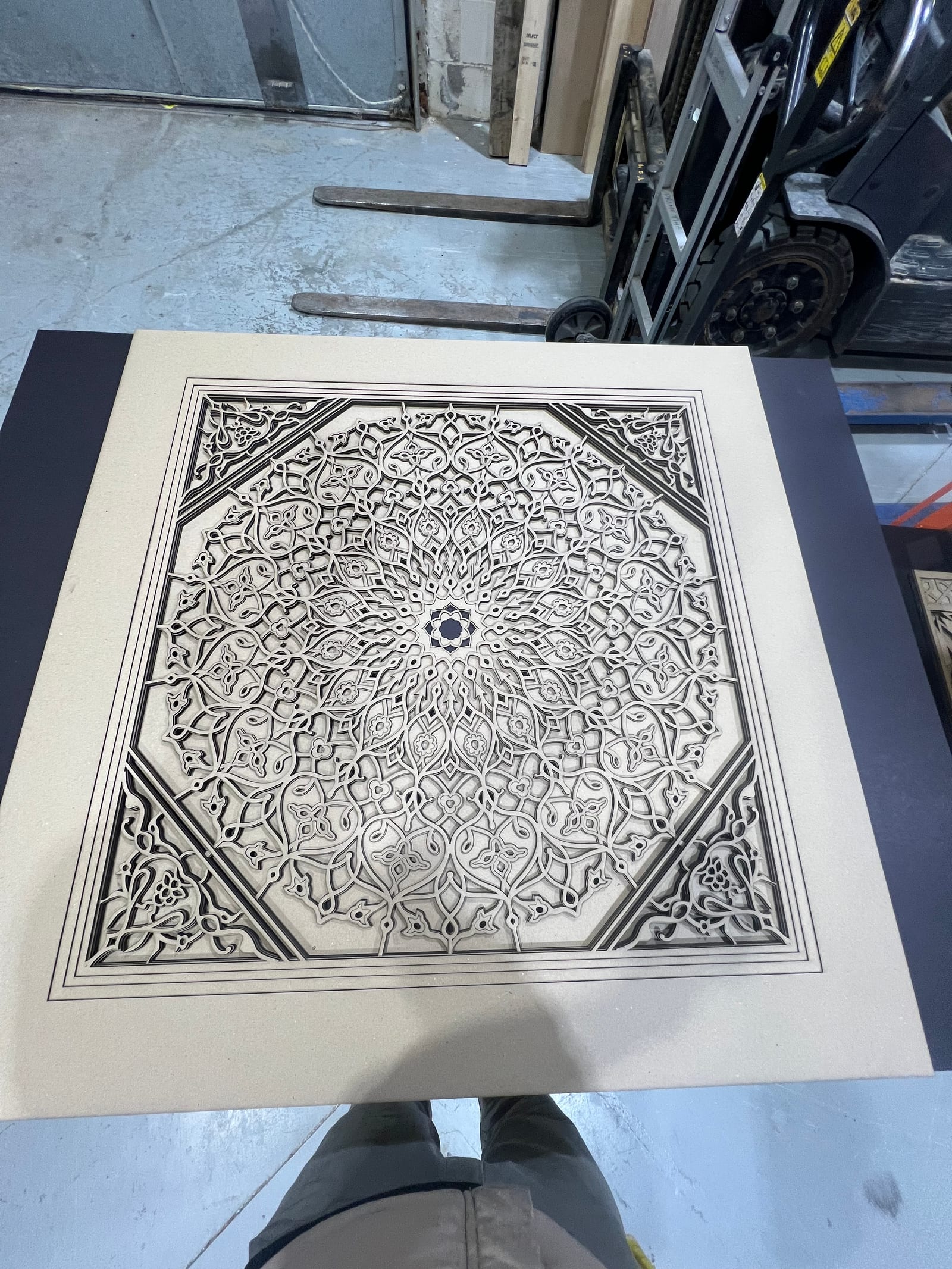
Layered paper art is exactly what it sounds like: artwork made by stacking multiple laser-cut sheets of paper, cardboard, or similar materials, with measured gaps between them, to produce dimensional pieces that read very differently from flat work on a wall. The technique is contemporary — its current form depends on laser cutting being affordable, which it only became in the last fifteen years or so — but the underlying impulse to layer and shadow goes back to the carved stone screens, mashrabiya lattices, and stucco walls of classical Islamic architecture, where depth was always part of the visual experience.
This post covers what the medium is, how it's made, who's working in it, how it relates to the classical Islamic tile and wood traditions, and what to consider if you're looking at buying or commissioning a layered piece. I work in this medium myself, so the practitioner perspective is mine; I've tried to be honest about both the strengths and the limits.
What makes the medium distinctive
A flat print of a geometric pattern reads as a graphic. A layered piece reads as an object.
The difference is the depth. When you stack five, eight, or thirteen layers of paper with a quarter-inch gap between each, you create a structure that catches light differently from different angles. The shadows between the layers become part of the pattern. Walk past a layered piece in a hallway and the composition shifts as you move; the shadows lengthen or contract depending on the light source. Stand directly in front and the pattern reads as a flat image; step to the side and you see the architecture of it.
The other distinctive property: scale flexibility. A single design file can be cut at 12 inches for a desk piece or 47 inches for a wall piece, with the same geometry, scaled to the buyer's space. Traditional materials don't scale as freely. A zellij panel has to be re-cut for each size; a marble inlay has to be redesigned. Digital files plus laser cutting let one design serve a range of sizes without the design work being repeated.
How it's made
The process has more in common with traditional Islamic craft than the materials suggest. Six steps:
1. Design. The pattern is created in software using mathematical rules — rosette geometry, the sine rule, multiples of 22.5° for the base angles. I use SVG Stack Studio, a tool I built specifically for this work, which lets me iterate on layer thickness, layer count, and color palette before any material is cut. Other practitioners use Adobe Illustrator with custom scripts, Rhino with Grasshopper, or proprietary CAD tools. The output is one SVG file per layer.
2. Laser cutting. Each layer is cut from cardboard or heavy paper on a laser cutter. Complex pieces have 8–13 layers; simpler pieces have 3–5. A single layer for a 47-inch piece takes 30 minutes to several hours of laser time depending on complexity. The cuts are precise to fractions of a millimeter, which matters because the layers need to align when stacked.
3. Cleaning. Laser-cut edges have a residue that needs to be sanded or wiped clean before painting. This step is tedious and there's no shortcut.
4. Priming and painting. Each layer is primed (typically white or grey acrylic primer) and then painted in its target color. I use Behr Premium spray paint for the base coat and hand-roll acrylic for details and corrections. The painting is layer-by-layer, with each layer drying fully before assembly.
5. Frame construction. The frame is a shadow box — an enclosed wood frame with measured depth, often with a back panel and sometimes with LED strip lighting hidden in the cavity. The depth has to match the total layer stack plus the gaps, so the front sits flush with the frame edge.
6. Assembly. The layers are mounted onto small spacers and stacked into the frame, with the deepest layer at the back and the outline layer (typically black) at the front. The stack is fixed permanently. The finished piece is ready to hang or install.
A complete piece takes 8–40 hours of human work depending on layer count and size, plus the design time amortized across however many copies of that design are sold.
Who else is working in this medium
Layered paper art as a global phenomenon is small but growing. A few practitioners worth knowing about:
- Eric Standley. The most prominent layered paper artist working today, based in Virginia. His pieces, often 50+ layers, draw on both Gothic cathedral architecture and Islamic geometric tradition. The work is in many major museum collections. (eric-standley.com)
- Mathilde Nivet. French artist working in paper installations and sculptural paper objects, more on the architectural side than the geometric.
- Beauty in the Stacks. A small but real community of laser-cutting hobbyists working in stacked paper, mostly through Etsy and Instagram, with quality varying widely.
- My own work (halat.art) sits at the intersection of the Islamic geometric tradition specifically and the layered paper medium generally. The references are Maghreb — zellij, the khatem star, the Moroccan octagonal pattern family — executed in paper at scales not practical in cut tile.
The medium itself is too new to have a canonical history yet. The earliest serious layered paper work probably dates to the late 2000s or early 2010s, when affordable laser cutters became available to studios outside of industrial settings. Standley's earliest pieces in this form date to around 2009–2010.
How it relates to classical Islamic art
Three points worth being honest about.
It's not zellij. A layered paper piece referencing the Bou Inania zellij is a translation, not a substitute. The materials are different (paper vs glazed terracotta), the durability is different (decades vs centuries), the social context of production is different (one artist with software vs a workshop of cutters and apprentices), and the experience in person is different (the depth and shadow are not what tile does). Calling a layered piece "zellij" would be wrong. Calling it "inspired by zellij" or "in the Maghreb tradition" is honest. See what is zellij for the classical tradition.
It's continuous with a deeper Islamic instinct, though. The Islamic decorative tradition has always used depth as a tool — in the carved stone screens of Cairo, in mashrabiya lattices of Egypt and the Hijaz, in the carved stucco of the Alhambra, in kündekari joinery in Turkish woodwork. The layered paper medium is a contemporary continuation of that instinct in materials the classical tradition didn't have access to. The work isn't a departure from the tradition; it's an extension of one specific thread within it.
The mathematics travels intact. This is the part I find most interesting as a practitioner. The geometry of a 16-pointed rosette is the same in paper as it is in tile, because the geometry is mathematical, not material. When I cut a rosette in paper following the same construction rules a 14th-century craftsman used in tile, the relationship between the angles and the petals is identical. The material changes; the mathematics doesn't. For the underlying math, see the math behind Islamic geometric patterns.
What to consider if you're buying or commissioning
Practical points if you're looking at layered work:
Durability. Paper, properly framed and protected from direct sunlight, lasts decades. Not centuries. If you're commissioning a piece for an institution that wants generational durability, traditional tile or carved wood is the right choice. For homes and most commercial spaces, layered paper is durable enough that the trade-off favors the medium's other benefits.
Lighting. Layered pieces look dramatically different under different lights. Direct lighting from above creates strong shadows; even ambient light reads the pattern more softly. LED strip lighting inside the frame can dramatize the depth significantly. Most layered pieces look best with at least some directional light hitting them from above or to the side.
Scale. This is where the medium has a real advantage over traditional Islamic art forms. A traditional zellij panel for a 12-inch desk piece doesn't really exist as a category — it'd be uneconomical to cut. A layered paper desk piece at 12 inches is a natural product, and the same design can be made at 47 inches for a wall. This is part of why I structure my own commissions across both scales.
Cost. Layered paper pieces typically cost 30–60% of what an equivalent zellij or carved-wood piece would cost. The labor is lower (no individual tile cutting), the materials are cheaper (paper vs glazed terracotta), and the framing is the same as for any framed art. The savings are real but the medium is a different category — buyers should compare layered paper to other contemporary work, not to traditional zellij at zellij prices.
For commissions specifically, see commissioning Islamic art — a guide for mosques, schools, and institutions. For how to choose any Islamic art for your home, layered paper or otherwise, see how to choose Islamic art for your home.
FAQ
What's the difference between layered paper art and a print?
A print is a flat reproduction of an image on a single surface. Layered paper art is dimensional — multiple sheets stacked with gaps between them, so the work has physical depth and casts shadows. A print of a geometric pattern reads as a graphic; a layered version of the same pattern reads as an object.
How long does layered paper art last?
Properly framed and kept out of direct sunlight, decades. The paper itself can yellow over time depending on quality and lighting conditions. Pieces framed behind UV-filtering glass and hung in normal interior lighting should last a lifetime. For generational durability, traditional Islamic art forms like zellij or carved wood are the right choice.
Is layered paper art expensive?
Less expensive than equivalent traditional Islamic art (zellij, carved wood, hand-illuminated work), more expensive than prints. A 12-inch desktop piece typically costs $200–$300; a 24×24 inch piece $600–$1,000; a 30×40 inch piece $1,200–$2,400; commissioned pieces $3,500 and up depending on size and complexity.
Can layered paper art include calligraphy?
Yes. Arabic calligraphy works particularly well in layered form because the script itself has dimensional qualities — letters can be raised, recessed, or surrounded by geometric framing. Combining layered geometric backgrounds with calligraphic foregrounds is one of the strongest applications of the medium for religious contexts.
Sources
- Wichmann, Brian, and David Wade. Islamic Design: A Mathematical Approach. Springer, 2017.
- Eric Standley's website — the leading practitioner of layered paper geometric art.
- For mashrabiya and Islamic architectural depth, see Doris Behrens-Abouseif, Cairo of the Mamluks.
- For kündekari joinery, see the V&A Museum collections.
- Castéra, Jean-Marc. Arabesques: Decorative Art in Morocco. ACR Edition, 1999.
Commissioning Islamic art: a guide for mosques, schools, and institutions
A practical guide to commissioning original Islamic art for mosques, schools, and homes. Process, timeline, costs, and what to ask before you start.
8 min readHow to choose Islamic art for your home
Choosing Islamic art for your home involves religious, aesthetic, and practical considerations. A room-by-room guide with sizing, placement, and budget advice.
8 min readIslamic art gift guide: weddings, Eid, Ramadan, and new homes
A practical guide to giving Islamic art as a gift — what works for weddings, Eid, Ramadan, new homes, and other occasions, by budget and recipient.
8 min read
See the work.
Mahmoud's first solo exhibit opens at Meridian Arts Centre during Toronto Doors Open, May 23–24, 2026.