Islamic art gift guide: weddings, Eid, Ramadan, and new homes
A practical guide to giving Islamic art as a gift — what works for weddings, Eid, Ramadan, new homes, and other occasions, by budget and recipient.
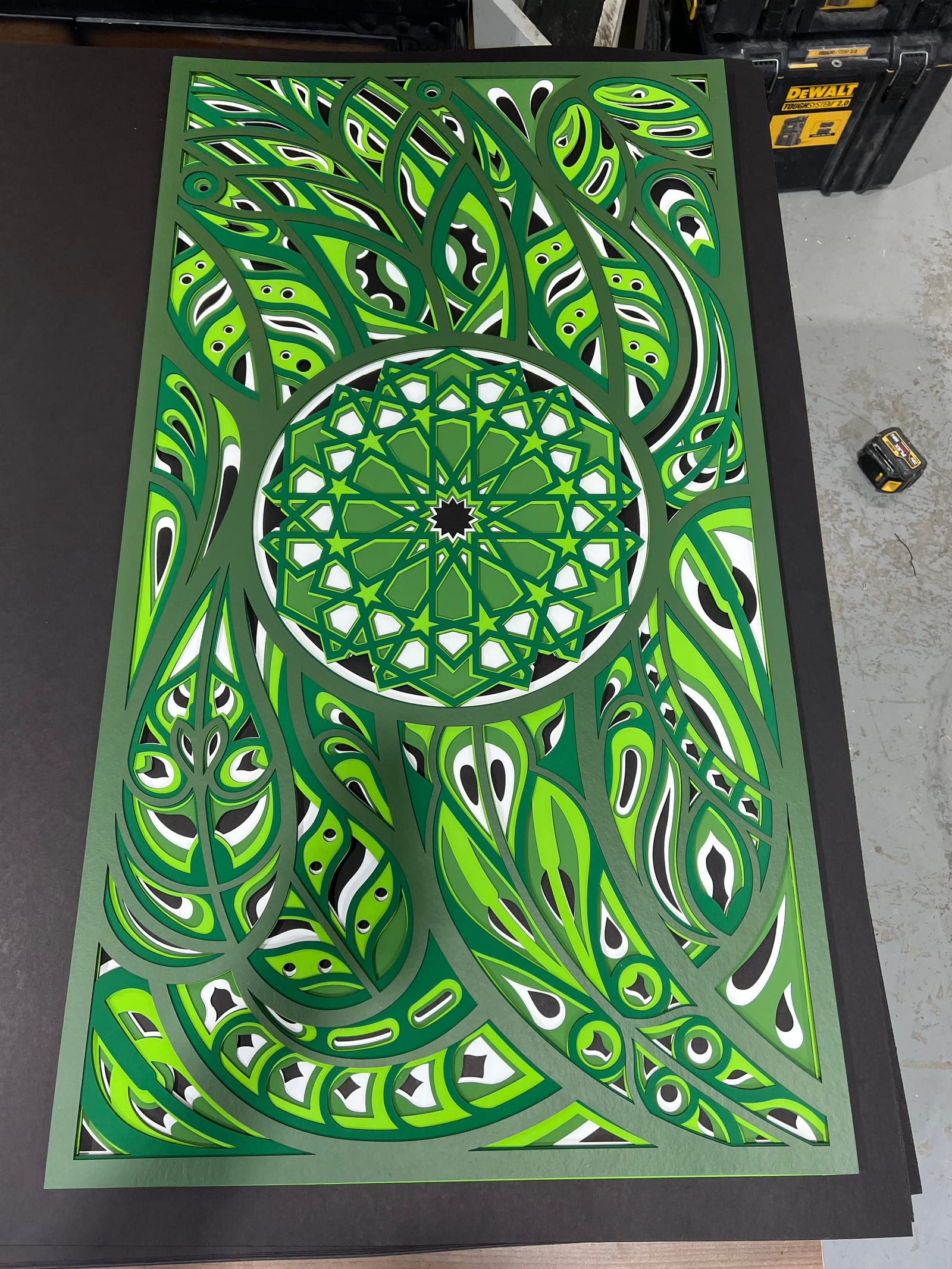
Giving Islamic art as a gift carries weight that most decorative gifts don't. The work itself draws on a fourteen-century tradition; the gift can mark a milestone — a wedding, a new home, the end of Ramadan, a graduation, a return from Hajj — in a way that lasts decades rather than weeks. This guide walks through what kinds of Islamic art make appropriate gifts for which occasions, what budget ranges work for each, and what considerations to keep in mind so the piece you give lands well with the person receiving it.
The principle: the best Islamic art gifts are specific to the occasion and the recipient. A generic Islamic-looking piece chosen from Amazon will read as generic. A piece chosen for who the recipient is and what the occasion means will read as a real gift.
The first decisions
Before browsing for a specific piece, decide three things.
Religious or secular? Islamic geometric and arabesque art has no specifically religious content and can be given to anyone, Muslim or not, who would enjoy beautiful geometric work. Calligraphy containing Qur'anic verses or the names of Allah is religious content; it should be given as a religious gift to recipients who will treat it with appropriate respect (not in bathrooms, not on the floor, at eye level or above).
The recipient's home style. Contemporary or traditional. Bold or restrained. Lots of art on the walls already, or sparse. A bold geometric piece in saturated color belongs in different homes than a hand-illuminated calligraphic piece with gold leaf. Match the piece to where it will live.
Budget. Islamic art ranges from $40 prints to $50,000 commissions. Most gift purchases land in the $100–$800 range. Higher-end gifts ($1,500+) are usually for major milestones, group gifts, or institutional gifts.
By occasion
Weddings. Traditionally, calligraphic verses about marriage are appropriate — Surah ar-Rum verse 21 ("And of His signs is that He created for you from yourselves mates that you may find tranquility in them") is the canonical Qur'anic reference to marriage. For non-religious gifts, a substantial geometric piece for the couple's first shared space works well; the symbolism of the unified pattern (one piece for a new shared home) carries some weight even without explicit religious content.
Budget guidance for wedding gifts:
- Close family member: $300–$1,500 (consider a substantial original piece or a group gift toward a commission)
- Close friend: $150–$500 (a quality print or mid-tier original)
- Acquaintance / coworker: $50–$200 (a museum-quality print or smaller piece)
If the couple's home isn't yet established, consider commissioning a piece to be delivered after they've settled in — the artist can size it for the eventual wall.
Eid (al-Fitr or al-Adha). Eid gifts tend to be more celebratory and colorful than other religious gifts. Geometric work in bright colors, calligraphic verses celebrating the occasion (Eid Mubarak, Kullu 'am wa antum bikhayr), or smaller pieces children can grow up with. Eid gifts to family members are common; gift exchanges between adults are less universal but increasingly common in diaspora communities.
Budget for Eid gifts:
- Within the immediate family: $50–$300
- Between extended family members or friends: $30–$150
- Children's Eid gifts: $20–$80 (smaller pieces, often educational like the 99 names of Allah or the Arabic alphabet)
Ramadan. Ramadan gifts tend to be more contemplative — calligraphy of Surah al-Fatihah, the Throne Verse (Ayat al-Kursi), or shorter Surahs commonly recited during the month. Hand-illuminated work on archival paper or vellum reads especially well as a Ramadan gift because of its association with traditional manuscript illumination. Geometric work in restrained palettes (deep blue, gold, cream) also works.
Budget guidance is similar to Eid but skewing toward calligraphic and religious pieces rather than geometric.
New homes. Among the most common contexts for Islamic art gifts. Appropriate pieces include Bismillah ir-Rahman ir-Rahim (In the name of God, the most Merciful), al-Hamdulillah (praise be to God), or a du'a for entering and leaving the home. For non-religious gifts, a geometric piece sized for the recipient's living room or foyer.
The new home gift is where commissioning makes the most sense, because the piece can be sized for the actual wall. Group gifts toward a commission (multiple family members contributing) often produce a far more substantial result than any single person's budget would allow.
Graduations and major milestones. Less traditional but increasingly common. Geometric work usually fits better than calligraphy here; the abstract pattern feels less prescriptive than a specific verse. Smaller pieces are common; the recipient can keep it on a desk or office wall.
Return from Hajj. Calligraphic gifts are almost universal here. A verse from one of the Hajj-related Qur'anic passages, or a depiction (in calligraphic form, never figurative) of the Kaaba. This is a category where the recipient will have specific preferences; ask before purchasing if possible.
Major institutional milestones (mosque openings, school dedications). This is the territory of commissioned work. Group gifts from congregations, parent groups, or alumni associations toward a substantial commissioned piece. Budget ranges run from $3,000 to $25,000+. See commissioning Islamic art for the full process.
By recipient
For older relatives. Traditional calligraphy in classical scripts (Naskh, Thuluth, Diwani) usually reads more comfortably than contemporary geometric work or modern Square Kufic. Hand-illuminated work on archival paper carries the right amount of weight and tradition.
For younger couples in contemporary homes. Bold geometric work in saturated color, often layered paper or modern interpretations, fits well. My own work and similar contemporary practitioners' work tends to land here. The pattern should be unambiguously beautiful even without religious framing.
For children. Educational pieces (the 99 names of Allah, the Arabic alphabet, simple geometric patterns in bright colors) work well. Smaller scale is appropriate; pieces should be safe (no fragile glass for younger children).
For non-Muslim friends. Geometric or arabesque pieces without text, ideally with a brief written explanation of what they are. The gift makes more sense if the recipient understands the tradition. Don't give Qur'anic calligraphy as a gift to non-Muslims unless they've specifically expressed interest in Islamic religious art.
For institutional spaces (mosques, schools, community centres). Larger scale, commissioned where possible, with calligraphy or coordinated geometric programs. The gift should be planned in coordination with the institution; surprise gifts of substantial art aren't always welcome because of placement and conservation considerations.
Things to get right
Three considerations that separate a thoughtful gift from a thoughtless one.
Sizing. Give a piece sized for an actual wall. A 12×12 inch piece given for a 12-foot wall reads as inadequate. If you don't know the recipient's space, give a piece in the 16×20 to 24×30 inch range, which works in most secondary spaces (hallway, study, smaller wall).
Framing. A framed piece is a real gift. An unframed print rolled in a tube is a project you've handed the recipient. Frame it before giving, or have it framed at the recipient's preference if you're certain they have a framer they like.
Provenance. A real piece by a real artist with a real story is a different gift from a generic print. Include the artist's name, the location and date of production, the title of the piece, and (if it's a print) the edition number. A small card included with the gift saying what it is and where it came from adds significant weight.
What to avoid
A few practical pitfalls:
Avoid generic mass-market Islamic decor for milestone gifts. A wedding gift that the recipient could have bought themselves for $30 on Amazon doesn't carry the right weight. Either commit to something substantial or give a different category of gift entirely.
Avoid sending Qur'anic calligraphy through standard mail. Religious texts have specific handling considerations. Use professional art shipping for any framed Qur'anic work.
Avoid giving art that the recipient has specific theological objections to. Some Muslims prefer not to display images of the Kaaba, or specific verses, for theological reasons. Asking the recipient or someone close to them in advance is often worth the small awkwardness.
Avoid major commitments without coordination. Commissioning a piece for someone else's space, without their input, can backfire. Group gifts coordinated with the recipient produce better outcomes than surprise gifts of substantial art.
For specific buying considerations, see how to choose Islamic art for your home. For Canadian buyers specifically, see where to find authentic Islamic geometric art in Canada.
FAQ
What's a good Islamic wedding gift?
For close family or substantial gifts, an original geometric piece for the couple's home (sized to a real wall, with the design selected to match their style) or a calligraphic piece of Surah ar-Rum verse 21 (the Qur'anic verse about marriage). For lighter gifts, a quality museum-reproduction print, framed, in the $150–$300 range. Group gifts toward a commission often produce the best results — multiple family members contributing toward a piece that lands in the $1,500–$4,000 range.
What's appropriate to give as an Eid gift?
Eid gifts tend to be more celebratory than other religious gifts — bright colors, geometric work, calligraphic verses celebrating the occasion. Within immediate families, $50–$300 is typical; for children, smaller educational pieces like the 99 names of Allah work well. Eid gifts are commonly framed; unframed prints feel incomplete.
Can I give Islamic art to a non-Muslim friend?
Yes, with some considerations. Geometric or arabesque pieces without specifically religious text are appropriate gifts for anyone. Include a brief note explaining what the piece is — the tradition, the pattern, the maker. Avoid Qur'anic calligraphy as a gift to non-Muslims unless they've specifically expressed interest in Islamic religious art, since the calligraphy carries explicit religious meaning that should be received with appropriate awareness.
How much should I spend on an Islamic art gift?
Depends on relationship and occasion. For weddings within close family: $300–$1,500. For Eid within immediate family: $50–$300. For new home gifts: $200–$800 typically, with commissioned pieces running higher. For institutional gifts (mosque openings, school dedications): $3,000–$25,000+, usually as group gifts toward commissions. For acquaintances and coworkers: $30–$150 for a quality print or smaller piece.
Sources
- Wichmann, Brian, and David Wade. Islamic Design: A Mathematical Approach. Springer, 2017.
- Met Museum essay, Islamic Art in the Home.
- Aga Khan Museum gift shop for guidance on appropriate gift formats.
Commissioning Islamic art: a guide for mosques, schools, and institutions
A practical guide to commissioning original Islamic art for mosques, schools, and homes. Process, timeline, costs, and what to ask before you start.
8 min readHow to choose Islamic art for your home
Choosing Islamic art for your home involves religious, aesthetic, and practical considerations. A room-by-room guide with sizing, placement, and budget advice.
8 min readLayered paper art: a contemporary medium for Islamic geometric design
Layered laser-cut paper is a new way to make Islamic geometric art accessible. How the medium works, who's pioneering it, and how it sits alongside the classical traditions.
8 min read
See the work.
Mahmoud's first solo exhibit opens at Meridian Arts Centre during Toronto Doors Open, May 23–24, 2026.